# American Pacific Reports Underground Assays from Breccia Pipe and Decline Sampling at Madison Project *2026-05-07T03:05:00-04:00* American Pacific Reports Underground Assays from Breccia Pipe and Decline Sampling at Madison Project Vancouver, British Columbia--(Newsfile Corp. - May 7, 2026) - **American Pacific Mining Corp. (CSE: USGD) (OTCQX: USGDF) (FSE: 1QC) (WKN: A422L8)**("**American Pacific**", or the "**Company**") is pleased to report assay results from underground sampling at its [Madison Copper-Gold Project](https://api.newsfilecorp.com/redirect/JkEgbH73xq)in Montana, including results from the recently identified breccia pipe and along the historical mine's decline ramp. These results follow the Company's [February 6, 2026](https://api.newsfilecorp.com/redirect/GzEmbu0Xw0)news release, which highlighted the identification of a breccia-hosted zone and an evolving geological model linking shallow skarn mineralization to a deeper porphyry source. The newly reported assays provide direct confirmation of mineralization within this interpreted feeder system and along associated underground development. The Q2 2026 porphyry target drilling will also test the down-plunge extent of this interpreted feeder system. "While we expected to see mineralization in samples collected from the breccia underground, the copper grades we sampled were better than we anticipated," said Eric Saderholm, Managing Director of Exploration. "What surprised us even more were the strong gold and copper values we found outside the breccia, along the main underground access. This tells us the mineralizing system is larger than we thought and extends to the south and west, giving us clearer drill targets for 2026 as we test the potential porphyry source at depth." **Highlights** - **High-grade copper up to 25%, gold up to 3.19 grams per tonne ("g/t") and silver up to 27.2 g/t**returned from underground sampling (see Table 1) - Sampling includes both of the following (see Figures 1 and 2): - Focused coverage of breccia pipe, and - Systematic sampling along the decline ramp, providing broader context to mineralization showing approximately **150 metres of a mineralized zone** - Results confirm a vertically and laterally continuous mineralized system **Table 1: Assay Results for Underground Samples ** [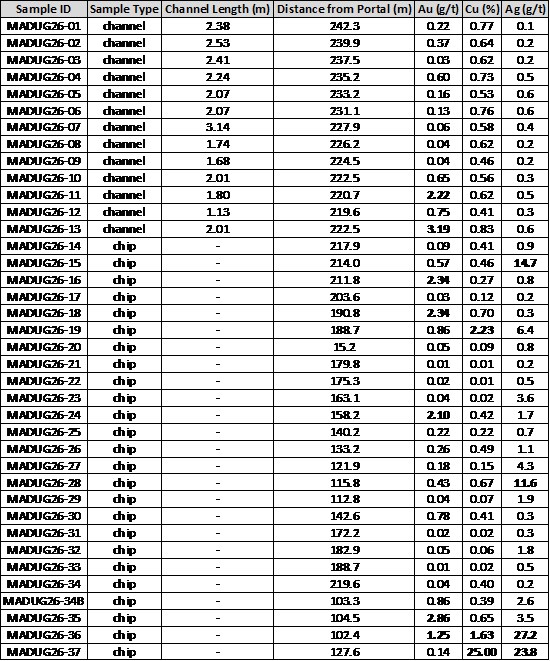](https://images.newsfilecorp.com/files/10322/296328_ec28f13c24df788a_001full.jpg) _**Notes: m = metres; Au = gold; Ag = silver; Cu = copper; g/t = grams per tonne; % = percent; (-) = not significant. **Samples were collected from underground and therefore cannot be located using GPS, and thus their location has been measured from a static, surveyed control point at the portal as noted in Figures 1 and 2. _ To view an enhanced version of this graphic, please visit: [https://images.newsfilecorp.com/files/10322/296328_ec28f13c24df788a_001full.jpg](https://images.newsfilecorp.com/files/10322/296328_ec28f13c24df788a_001full.jpg) [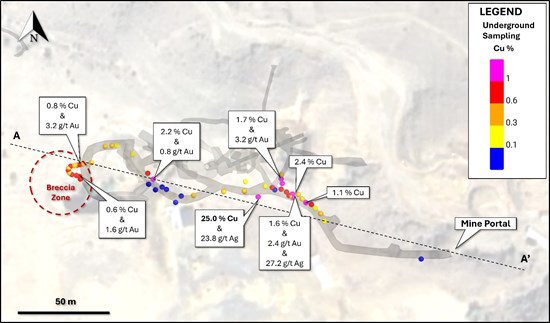](https://images.newsfilecorp.com/files/10322/296328_ec28f13c24df788a_002full.jpg) _Figure 1: Plan view showing lateral mineralization and breccia zone (red)._ To view an enhanced version of this graphic, please visit: [https://images.newsfilecorp.com/files/10322/296328_ec28f13c24df788a_002full.jpg](https://images.newsfilecorp.com/files/10322/296328_ec28f13c24df788a_002full.jpg) **Sampling Demonstrates Mineralization Beyond a Single Zone** Underground sampling was designed to evaluate both the breccia pipe and the surrounding decline ramp, providing a more complete understanding of the mineral system. **Key observations include:** - The breccia pipe hosts the strongest grades, with intense alteration and both sulfide and oxide-rich mineralization - Sampling along the decline ramp confirms mineralization extends beyond the pipe, occurring within structurally controlled zones and favourable host rocks - Mineralization along the ramp includes disseminated to semi-massive sulfides, consistent with fluid movement along the underground corridor This broader sampling approach demonstrates that mineralization is not isolated, but instead part of a continuous hydrothermal system. **Assays Support Feeder Zone Interpretation** Results from both the breccia pipe and decline sampling confirm the following: - A strong copper-gold association - Consistent presence of porphyry pathfinder elements - Increasing intensity of alteration and mineralization within structurally focused zones The breccia pipe is interpreted as a primary fluid conduit, while mineralization along the decline ramp reflects fluid dispersion outward from this core structure. [![Cannot view thi