# Prismo Metals Closes Strategic Transaction with Blade Resources *2026-03-05T18:40:00-05:00* Prismo Metals Closes Strategic Transaction with Blade Resources (TheNewswire) | [](https://prismometals.com/) | | | | | | | --- | --- | --- | --- | --- | --- | | [](https://thenewswire.com/api/apps/tnw/r?i=1LYzFD8lw&m=fac) | [](https://thenewswire.com/api/apps/tnw/r?i=1LYzFD8lw&m=twi) | [](https://thenewswire.com/api/apps/tnw/r?i=1LYzFD8lw&m=lin) | [](https://thenewswire.com/api/apps/tnw/r?i=1LYzFD8lw&m=you) | [](https://thenewswire.com/api/apps/tnw/r?i=1LYzFD8lw&m=ins) | | Provides Drilling Update at Silver King Vancouver, British Columbia, March 5th, 2025– TheNewswire -Prismo Metals Inc. (“Prismo” or the“Company”) (CSE: PRIZ) (OTCQB: PMOMF) is pleased to announce the closing of its previously announced transaction with Blade Resources Inc. (“Blade”) pursuant to which Prismo has assigned all of its rights, interests and obligations in the Hot Breccia copper project, located in the heart of the Arizona copper belt (the “Transaction”), to Blade. Alain Lambert, CEO of Prismo, commented: “In our opinion, Hot Breccia is one of the most compelling copper exploration opportunities in North America. We remain committed to advancing it toward drilling. The principals and financial backers of Blade have a long history and strong track record in raising significant capital for exploration programs of the scale required at Hot Breccia. We expect this will result in Hot Breccia being drilled this year.” For additional commentary on the Transaction, please watch the interview Alain Lambert gave to Radius Research: Drilling Update at Silver King Dr. Craig Gibson, Chief Exploration Officer of Prismo provided an update on the current drill program at the Company’s Silver King project located in Arizona: “The first drill hole at Silver King, SK-26-01 was drilled vertically and was successful in traversing the mineralized body as projected from the historic workings and reached a total depth of 477 feet (145 meters). Two small voids that are likely underground workings were intersected near the elevation of the 114’ level and quartz veining extended from this level for about 100 feet down hole. Visible sulfide minerals are present in several intervals and the presence of silver minerals, including native silver, was confirmed through visual identification and with a handheld XRF analyzer. Freibergite (Ag bearing tetrahedrite), stromeyerite (AgCuS) and probably acanthite (AgS) are also present. The second hole, SK-26-02 is currently at a depth of 155 feet.” Phase 1 Drill Program Highlights: - 1,000 meters of diamond drilling to test the upper portion of the steeply plunging, pipe-like Silver King mineralized body - Fully funded program - Additional drilling to test lower down in the mineralized structure and mineralized areas adjacent to the historic mine may also be completed [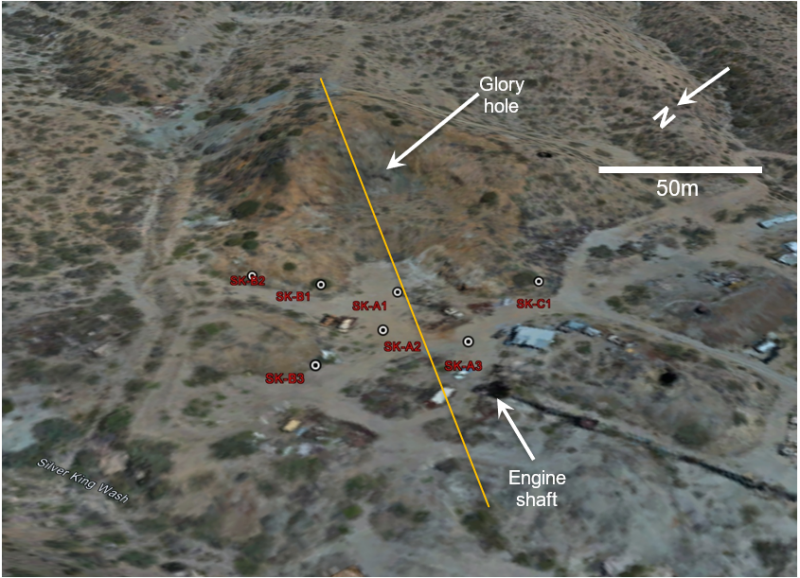](https://www.thenewswire.com/data/tnw/clients/img/c98b1709a16d8d0a14070851a17903f5.png) Click Image To View Full Size Fig. 1. Permitted drill sites planned for initial Phase I drilling at the Silver King mine shown by white dots. The orange line indicates the approximate location of the cross section in Fig. 2. View looking south-easterly. Drilling is currently focused on testing the upper portion of the steeply west-dipping pipelike stockwork and breccia zone that historically produced high-grade silver and base metals (Fig. 2), as well as targets adjacent to and beneath historic workings. Initial drilling is estimated at 1,000 meters in nine holes. A second phase of drilling will be dedicated to testing at deeper levels and areas adjacent to the historic mine. The silver mineralization at Silver King is similar to that of portions of the nearby Magma Mine, and exploration for nearby copper mineralization is warranted. The Magma Mine and Silver King Mine share a common regional geological framework in the Superior Mining District, characterized by a Precambrian to Paleozoic stratigraphic sequence including Pinal Schist basement, diabase sills, the Apache Group sediments, and Paleozoic limestones like the Martin Formation, all tilted eastward and intruded by Laramide-age igneous bodies such as quartz diorite stocks and andesite sills. While both exhibit fault-controlled mineralization—east-trending faults and veins with hydrothermal alteration like silicification and potassic zoning—Silver King features epithermal-mesothermal silver-dominant veins in porphyry with minerals like stromeyerite, tetrahed